
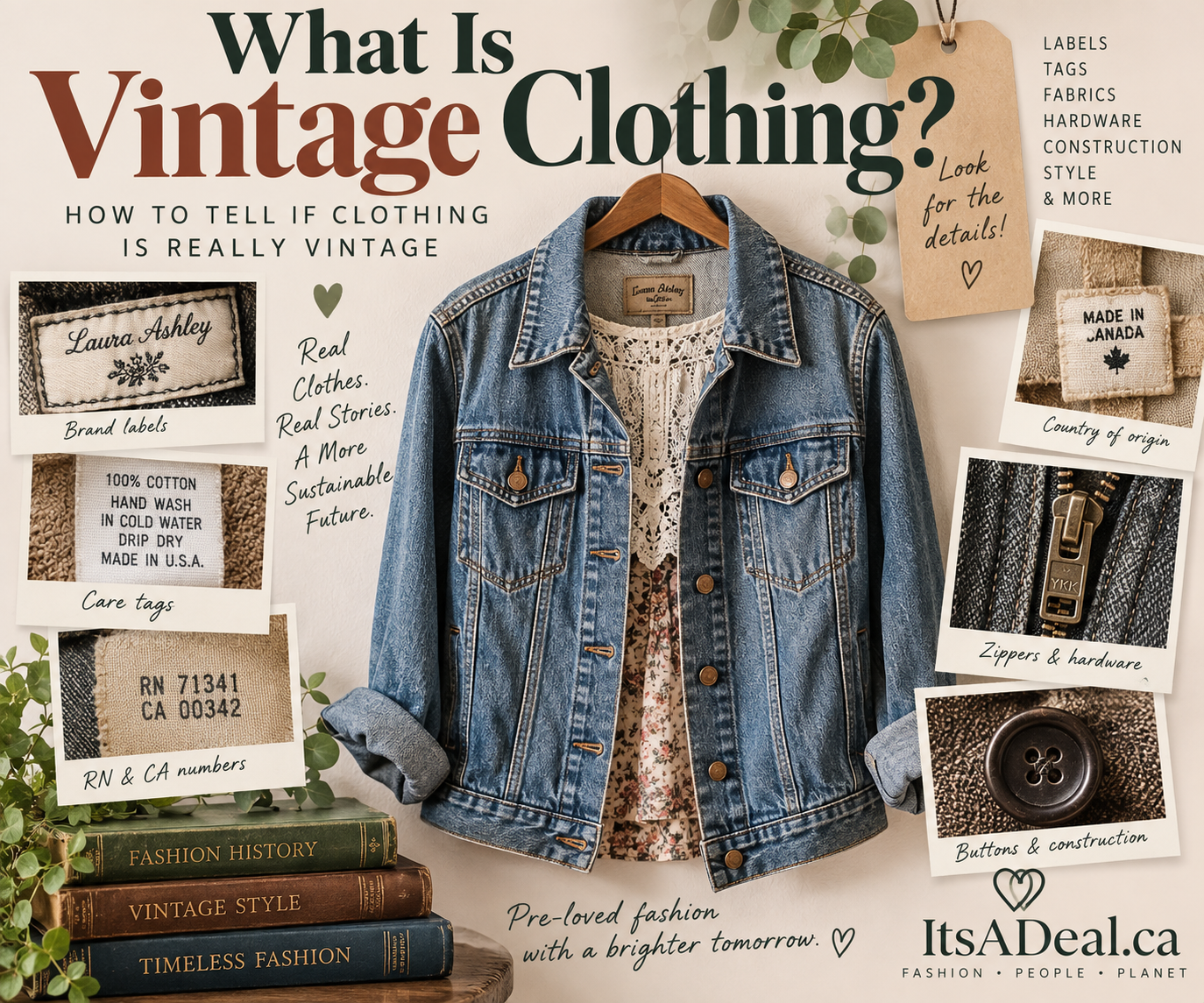
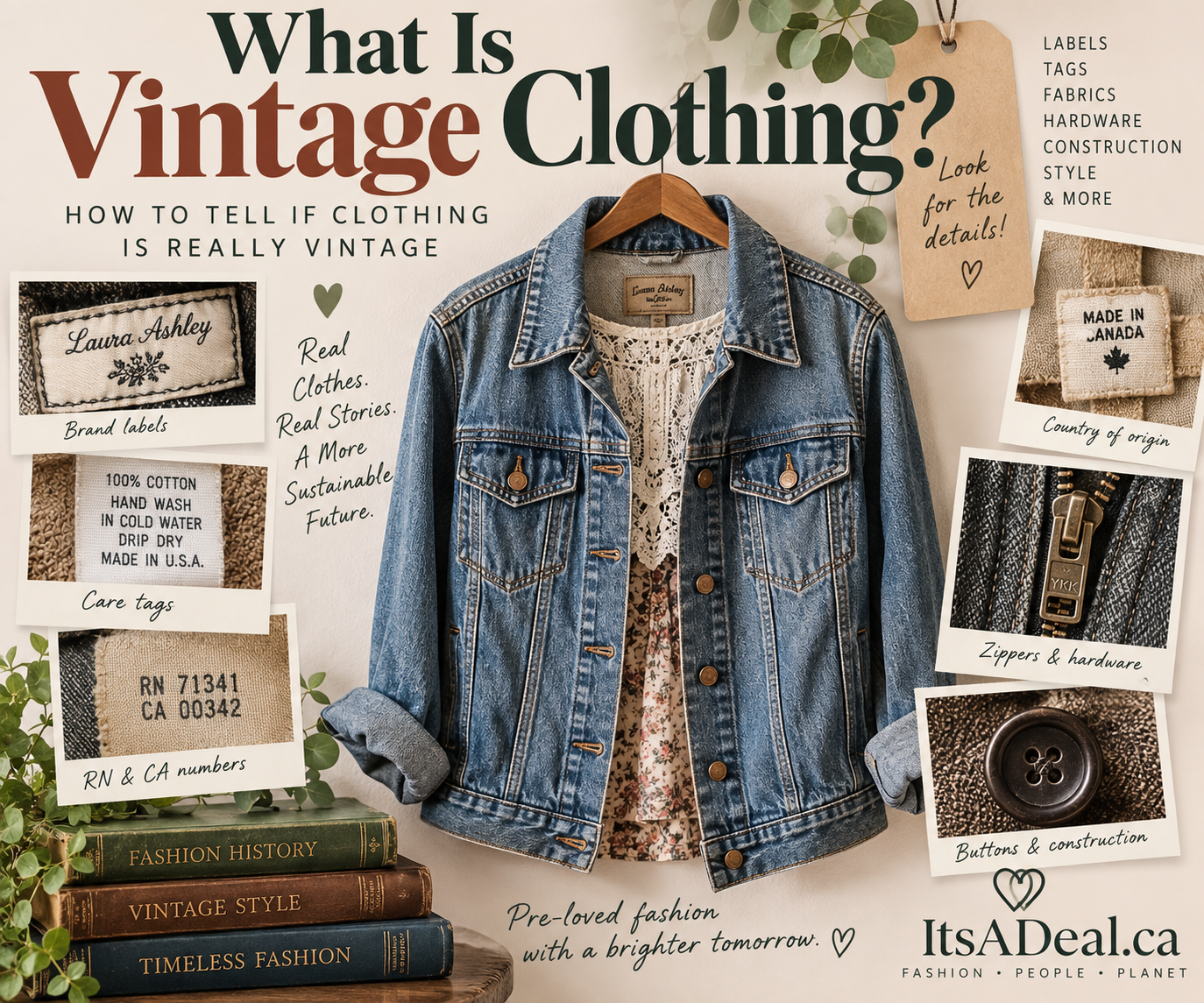
What Is Vintage Clothing? How to Tell If Clothing Is Really Vintage
Have you ever picked up an interesting piece of clothing at a thrift store and wondered, “Is this actually vintage?”
The word vintage gets used a lot in fashion. Sometimes it describes a genuinely older garment, while other times it's simply being used to describe something with a retro look.
There's a difference.
Learning to recognize truly vintage clothing can make thrifting even more interesting — and sometimes the smallest details on a garment can reveal quite a bit about its history.
How Old Does Clothing Have to Be to Be Vintage?
A commonly used guideline in the resale and collecting world is that an item should be at least 20 years old to be considered vintage.
That means something manufactured in 2006 can now technically qualify as vintage in 2026.
Yes — the early 2000s really are vintage now!
Clothing approaching or exceeding 100 years old is generally described as antique rather than simply vintage.
It's also important to distinguish vintage from retro. A new dress designed to look like something from the 1950s may be retro or vintage-inspired, but that doesn't make the garment itself vintage.
Start With the Clothing Label
One of the first places to look is the brand label.
Labels change over time. Companies update logos, fonts, colours and even the way their brand name is written.
If you find an unfamiliar or older-looking label, don't immediately assume the garment is vintage. Instead, research the label and compare it with documented examples from different periods.
Sometimes a label can narrow a garment down to a surprisingly specific era.
Don't Ignore the Care Tag
Turn the garment inside out and look for its care and fibre-content labels.
Modern clothing tends to provide extensive information about fabric content, washing instructions, manufacturer/importer information and other details. Older garments can look quite different.
For U.S. garments, care labels are an especially interesting clue because mandatory care-labelling requirements date to the early 1970s.
That doesn't mean “no care tag = definitely pre-1970s.” Tags can be removed, garments can be altered, and clothing made in different countries followed different requirements.
Think of the care label as one piece of evidence rather than proof by itself.
Look for RN and CA Numbers
Those little numbers on clothing tags aren't necessarily meaningless.
On American clothing, you may encounter an RN (Registered Identification Number) associated with a company involved in manufacturing, importing, distributing or selling the garment.
On Canadian textile labels, you may find a five-digit identification number preceded by CA. A Canadian business involved in manufacturing, importing or selling textile products can use its registered CA number in place of its business name and address.
These numbers don't simply translate into a manufacturing date, but researching the company associated with them can provide another clue about a garment's history.
Check Where It Was Made
Country-of-origin information can also help.
Manufacturing shifted considerably between countries and regions over the decades. A country listed on a label can therefore provide supporting evidence when combined with the brand's history, label design and construction.
Again, “Made in ___” isn't enough to date a garment by itself.
We're building a case from multiple clues.
Examine How the Garment Was Made
Sometimes the clothing itself tells the story.
Look closely at:
- Zippers, snaps, buttons and other hardware
- Seams and stitching
- Fabric and lining
- Shoulder pads and garment structure
- Hem construction
- Embroidery and embellishments
- Fasteners and closures
Construction methods and materials change with fashion and manufacturing technology.
A metal zipper doesn't automatically mean you've discovered a valuable vintage treasure, for example, but hardware can become useful evidence when everything else points toward a particular period.
Style Can Help — But Don't Trust It Alone
Silhouette can provide clues too.
Certain cuts, prints, collars, sleeves, waistlines and fabrics are strongly associated with particular decades.
The problem is that fashion repeats itself.
A modern 1970s-inspired blouse can look remarkably convincing. So can a newly manufactured Y2K-style top.
Use the style to give you a starting point, then investigate the labels and construction.
Does Vintage Mean Valuable?
This is one of the biggest misconceptions about vintage clothing.
Old does not automatically mean valuable.
A garment's resale value can depend on its brand, rarity, condition, size, style, current demand, historical significance and sometimes its provenance — the documented story of where it came from or who used it.
Some vintage clothing is highly collectible.
Some is worth $10.
And that's perfectly fine. Something doesn't need to be expensive to be an interesting piece of fashion history.
What About Clothing From the 2000s?
This one can take a little getting used to!
Under the commonly used 20-year guideline, we're now reaching the point where genuine clothing from the early-to-mid 2000s can qualify as vintage.
That's also why accurately identifying vintage matters. The definition moves forward every year.
Something doesn't have to look like it came from your grandmother's closet to be vintage anymore.
How We Identify Vintage at ItsADeal.ca
At ItsADeal.ca, we don't want to call something vintage simply because it looks old.
When we're able to identify a piece as vintage, we look for supporting evidence such as the label, tag information, construction, country of manufacture, hardware, style and other details that can help establish its approximate age.
Sometimes the evidence is strong enough to call it vintage.
Sometimes it isn't.
And when we can't establish that confidently, we'd rather describe the garment for what it is than use vintage simply because it sounds good.
The Fun Is in the Hunt
One of the best things about secondhand shopping is never knowing exactly what you're going to find.
A strange label, an unusual zipper or a tiny number hidden on an inside tag might be the beginning of discovering that the piece in your hands has been around for decades.
So next time you're thrifting, look beyond the style. Check the tags. Examine the construction. Do a little research.
You might be holding a small piece of fashion history.
Happy thrifting!
From ItsADeal.ca — affordable fashion, secondhand finds and unique pieces waiting for their next chapter.